Choosing outdoor furniture in 2026 requires more than comparing color, price, and showroom appearance. The important question is practical: What is the difference between PE rattan and natural rattan? PE rattan is a synthetic polyethylene material, often wrapped around aluminum frames. Natural rattan is a plant-based cane with visible grain, slight irregularities, and a warmer tactile feel. They can look similar in photographs. They behave differently on a wet balcony.
Dr. A. N. Rao, a tropical forest-products researcher, explains, “Rattan is a natural material, and its performance depends heavily on species, treatment, and use conditions.” This reminder matters. Natural rattan may feel authentic and lightweight, but untreated cane can absorb moisture, fade, or develop mildew. It usually suits covered patios, sunrooms, and dry indoor spaces. PE rattan handles changing weather better, especially when paired with powder-coated aluminum and UV-resistant resin. Still, “weather-resistant” does not mean maintenance-free. Cheap strands may split after intense sunlight. Frames may rust around poorly sealed joints.
This guide, How to Choose PE Rattan or Natural Rattan in 2026?, examines those details closely. You will compare durability, comfort, sustainability, cleaning effort, repair options, and long-term value. A small sample can reveal loose weaving. A close look can expose sharp edges. The honest answer is not always convenient: natural rattan may win emotionally, while PE rattan may win practically. Personal preference matters, but climate should lead the decision. Consider your rain, sunlight, storage space, and daily use before choosing the more attractive option.
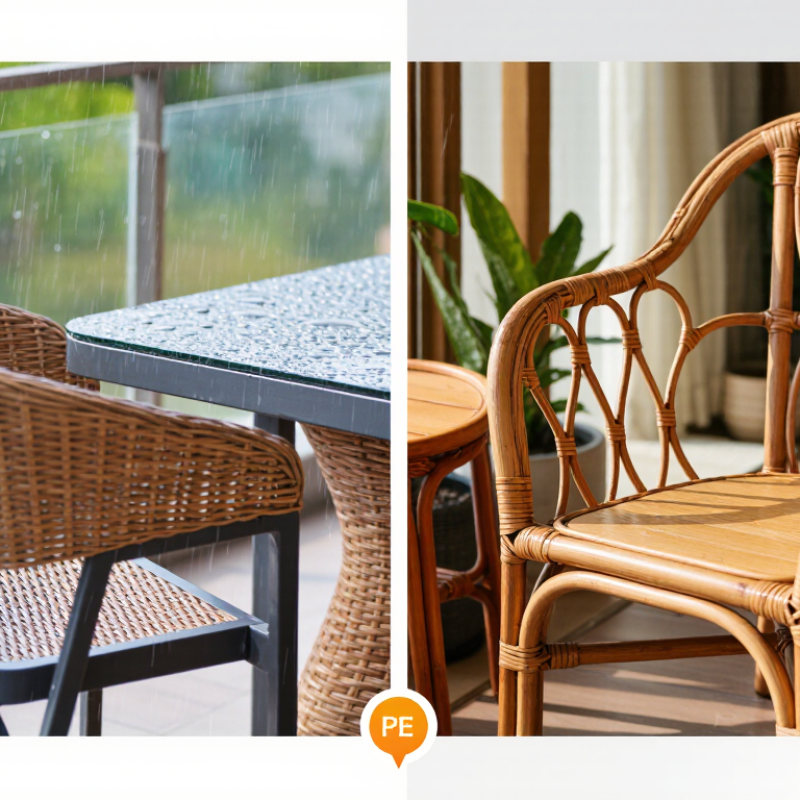
PE rattan is a synthetic weaving material made from polyethylene strands. It is designed to imitate the texture of natural rattan. Natural rattan comes from climbing palms and remains a renewable, plant-based material when harvested responsibly. The difference is visible in the details. PE strands usually show consistent color and repeated patterns. Natural rattan has small variations, warmer tones, and occasional surface marks.
The 2026 market context is more complex than a simple “natural versus synthetic” choice. Grand View Research’s Rattan Furniture Market report projects steady growth through 2030, supported by outdoor living and hospitality demand. Meanwhile, industry reports from the International Trade Centre show continued trade activity in furniture and woven plant materials, although classifications can combine rattan, bamboo, and other products. These figures are useful, but not perfectly comparable. That limitation matters. PE rattan can resist moisture and simplify maintenance, yet it depends on fossil-based polymers and may be difficult to recycle after mixed-material furniture is dismantled. Natural rattan can provide stronger material character, but humidity, sunlight, and poor sealing may shorten its service life.
Tips: Check the frame before judging the weave. Ask for UV-resistance data, polymer specifications, and care instructions for PE rattan. For natural rattan, inspect the cane diameter, joint quality, finish, and sourcing documentation. A showroom sample can look convincing. Long-term performance is harder to predict. Consider climate, repair access, and expected use before choosing the material.
How to Choose PE Rattan or Natural Rattan in 2026?
When selecting rattan furniture, compare density rather than judging thickness alone. Higher-density PE rattan usually feels firmer and resists crushing during daily use. However, density varies between product formulas and cannot prove long-term quality. Natural rattan has a lighter, more organic structure. It may feel warmer in the hand, but its fibers can absorb moisture through small surface gaps.
Tensile strength matters where strands bend around frames or support body weight. In practical inspections, well-woven PE rattan keeps its shape after repeated pulling and flexing. Natural rattan can also provide excellent strength along its fibers. Its performance depends heavily on fiber maturity, weaving quality, and frame tension. A beautiful sample may hide weak points. Check corners, joints, and stretched areas closely.
UV stability becomes critical beside windows, balconies, and pool areas. Quality PE rattan should contain UV stabilizers, but ask for test data instead of trusting color alone. Fading can appear slowly under strong sunlight. Natural rattan usually needs protective coatings and sheltered placement. Moisture resistance is another clear dividing line. PE rattan does not readily absorb water, while natural rattan may swell, soften, or develop mildew when ventilation is poor. Still, PE rattan is not waterproof furniture; trapped water can damage its frame and fasteners. Request tensile, UV-weathering, and moisture-resistance results from the supplier. Real conditions remain harsher than laboratory testing.
Choosing PE rattan or natural rattan in 2026 requires evidence beyond appearance. Grand View Research’s 2024 Outdoor Furniture Market report valued the sector at about USD 46 billion in 2023. Outdoor exposure now matters commercially. PE rattan usually offers more consistent moisture resistance, while natural rattan provides warmer texture but needs careful sealing and sheltered placement.
ASTM D638 can measure PE rattan’s tensile strength, elongation, and modulus. Cut samples from the actual strand, not only laboratory resin. Record stretching around bends and connector points. ASTM D638 is designed for plastics, so it should not be treated as a complete test for natural rattan. Natural fibers need moisture conditioning and separate strength evaluation. ISO 4892-3 exposes polymer samples to fluorescent UV and condensation cycles. Inspect fading, surface chalking, cracking, and brittleness after exposure. A passing color result alone is not enough. UV damage can hide inside a glossy surface.
Tips:
Request test reports showing specimen thickness, conditioning, cycle duration, lamp type, and failure changes. Compare before-and-after tensile values. Smithers’ 2024 materials-weathering analysis highlights that accelerated testing supports comparison, but it cannot perfectly predict every climate. That limitation deserves attention. Coastal salt, dust, heat, and poor drainage may produce harsher results than a laboratory cycle. In practice, I would choose PE rattan for exposed commercial seating, but natural rattan can work beautifully under a covered veranda with regular maintenance. Testing reduces guesswork, not responsibility.
Service life is often the practical deciding factor. In outdoor furniture, PE rattan commonly lasts about 5–10 years, while natural rattan usually lasts 3–5 years. These figures are industry estimates, not guarantees. A south-facing balcony, strong ultraviolet exposure, and standing rain can shorten either range. Covered patios usually produce better results.
The U.S. Forest Products Laboratory’s Wood Handbook explains that moisture cycling encourages swelling, cracking, and biological deterioration in plant-based materials. That evidence supports the shorter outdoor life of natural rattan. Natural fibers also need regular drying, gentle cleaning, and protection from prolonged humidity. They feel warmer and more authentic, but maintenance is less forgiving.
PE rattan is more moisture-resistant. Its expected 5–10-year life still depends on resin quality, weave density, and UV stabilizers. ISO 4892-3 and ASTM G154 provide accelerated weathering methods, but neither standard promises a specific service life. That distinction matters. Test exposure is not the same as a real garden.
Look closely at exposed edges. Brittle strands, fading, and loose wrapping are early warning signs. Salt air can be especially demanding.
I would choose PE rattan for frequent outdoor use and natural rattan for sheltered spaces. The numbers help, though they remain imperfect. Real placement matters more than a brochure estimate.
How to Choose PE Rattan or Natural Rattan in 2026?
Climate should guide the first decision. PE rattan handles humid patios, poolside splashes, and strong sunlight better than untreated natural rattan. Check the frame, drainage, and UV rating, not just the weave. ISO 4892-3 provides a recognized method for testing outdoor plastic weathering. Natural rattan feels warmer and more authentic indoors or beneath a covered roof. It dislikes standing water. A rainy balcony can expose that weakness quickly.
Maintenance changes the yearly cost. PE rattan usually needs mild soap, a soft brush, and winter storage. Natural rattan may need sealing, careful drying, and occasional repair. My practical estimate uses this formula: purchase price plus maintenance, divided by expected service years. A $600 PE set lasting eight years costs about $75 yearly before repairs. A $400 natural set lasting five years costs $80 yearly. These are working estimates, not guarantees. Real furniture behaves badly when neglected.
Sustainability needs a closer look. The International Resource Panel reported that global material extraction could rise 60% by 2060. PE is plastic, so its end-of-life route matters; the OECD reported only 9% of global plastic waste was recycled in 2019. Natural rattan is plant-based and can support forest livelihoods, but responsible harvesting and durable finishing remain essential. Ask for traceable sourcing and repairable construction. Cheaper is sometimes wasteful. A sheltered room may favor natural rattan, while exposed coastal weather often justifies PE rattan’s longer service life.
| Decision Factor | PE Rattan | Natural Rattan |
|---|---|---|
| Best overall use |
Best for outdoor use Suitable for patios, balconies, terraces, gardens, and covered or uncovered seating when the supporting frame and cushions are also weather-rated. |
Best for indoor use Well suited to living rooms, bedrooms, sunrooms, and covered dry areas. It is generally not the first choice for permanently exposed outdoor furniture. |
| Hot, sunny climate | Usually performs well when the material contains UV stabilizers. Prolonged intense sunlight can still cause fading, surface aging, or brittleness over time, especially in low-grade products. | Requires protection from direct sun. Repeated UV exposure can dry the fibers, fade the surface, and reduce flexibility. Use curtains, shade, or a covered position. |
| Rain, humidity, and coastal air | The plastic weave itself has low water absorption and tolerates rain better than natural rattan. Drainage, ventilation, rust-resistant hardware, and quick-drying cushions remain important. | Water and high humidity can cause swelling, mildew, staining, and loss of strength. Keep it dry, avoid standing water, and do not leave untreated pieces outdoors through wet seasons. |
| Cold and temperature changes | Generally suitable for seasonal outdoor use. Freezing conditions can make some plastics less flexible, so avoid impact, dragging, or heavy loads when the material is very cold. | Best kept in a stable indoor environment. Rapid changes between damp and dry conditions may promote cracking, loosening, or distortion. |
| Routine cleaning | Low maintenance: remove dust, then wash with mild soap and water. Rinse thoroughly and allow the weave to dry. Avoid abrasive cleaners, solvents, and high-pressure washing. | Moderate maintenance: dust or vacuum with a soft brush and wipe with a lightly damp cloth. Avoid soaking, harsh chemicals, and aggressive scrubbing. |
| Typical protective maintenance | Inspect annually for fading, cracked strands, loose wrapping, rust, and drainage problems. Use a breathable cover and store cushions dry. PE does not normally require oiling. | Inspect several times per year in humid areas. Keep away from damp floors, use a breathable cover, and apply a suitable rattan or wood conditioner only when recommended for the specific finish. |
| Expected service life | Approximately 8–15 years for well-made outdoor furniture with UV-stabilized PE, a protected frame, and reasonable care. Extreme sun, salt, frost, or poor drainage may shorten this range. | Approximately 5–15 years indoors, depending on fiber quality, finish, humidity, and use. Outdoor exposure without adequate shelter can reduce service life substantially. |
| Repairability | Damaged strands can sometimes be replaced, but color matching may be difficult. Structural repairs usually depend on the frame design and the availability of matching weave. | Individual natural strands can often be repaired or rewoven by a specialist. Repairs may blend more naturally, although severely dried or fractured material can be difficult to restore. |
| Material origin and renewability | Made from polyethylene, a fossil-fuel-derived plastic. It is durable and lightweight, but it is not biodegradable. Environmental performance depends on product life, recycled content, and end-of-life handling. | Made from plant-based climbing palms, commonly harvested as a renewable natural fiber when responsibly managed. It is biodegradable under suitable conditions, although coatings, adhesives, and mixed frames may not be. |
| Recycling and end of life | Clean, single-polymer PE may be recyclable where suitable collection exists. Woven furniture often contains mixed plastics, metal frames, foam, coatings, and fasteners, which can make recycling difficult. | The untreated fiber can biodegrade more readily than plastic, but finished furniture may include varnish, paint, metal, synthetic binding, foam, or composite boards that require separation. |
| Typical purchase cost for a four-seat set | Approximately US$600–1,500 for ordinary residential furniture, excluding premium frames, cushions, delivery, and assembly. | Approximately US$400–1,200 for ordinary residential furniture. Handcrafted construction, high-quality finishes, and specialist weaving can increase the price. |
| Estimated annualized material cost | Approximately US$40–190 per year, calculated from the purchase range divided by an expected 8–15-year service life. Outdoor covers, cushion replacement, and frame repairs are not included. | Approximately US$27–240 per year, calculated from the purchase range divided by an expected 5–15-year service life. Indoor use generally produces the lower end; exposed outdoor use can produce a higher total cost. |
| Lowest long-term risk | Usually the lower-risk choice for wet, sunny, or coastal outdoor environments, provided the PE is UV-stabilized and the frame is corrosion-resistant. | Usually the lower-risk choice for dry indoor environments where natural appearance, repairability, and plant-based material are priorities. |
| Recommended choice in 2026 | Choose PE rattan for exposed outdoor furniture, humid climates, frequent cleaning, and buyers who prioritize weather resistance and predictable maintenance. | Choose natural rattan for indoor or well-sheltered spaces, buyers who prioritize renewable natural fiber and repairability, and situations where moisture exposure can be controlled. |
Cost figures are indicative 2026 US-dollar ranges for a typical four-seat residential set, not quotations. Actual annual cost varies with construction quality, local prices, climate, covers, cushions, storage, repairs, and replacement frequency.
PE rattan uses polyethylene strands made to imitate natural rattan’s woven texture. The color and pattern usually look highly consistent. Appearance can mislead.
Natural rattan comes from climbing palms and remains plant-based when harvested responsibly. Its strands often show warmer tones, small variations, and occasional surface marks. Those details create character.
PE rattan usually provides more consistent moisture resistance. Natural rattan needs sealing, shelter, and regular maintenance in humid conditions. Poor drainage can shorten its life.
It can be a practical choice where furniture faces moisture and frequent use. Ask for UV-resistance data, polymer specifications, and detailed care instructions. I would still inspect the frame carefully.
Natural rattan can work under a covered veranda with limited direct sunlight. Regular sealing and careful cleaning remain important. It is less forgiving.
ASTM D638 can measure tensile strength, elongation, and modulus for plastic strands. Samples should come from the actual strand, not only raw laboratory resin. Connector points deserve attention.
ISO 4892-3 exposes polymer samples to fluorescent ultraviolet light and condensation cycles. Inspect fading, chalking, cracking, and brittleness after exposure. A bright surface proves little.
No test perfectly predicts every climate or installation. Coastal salt, dust, heat, and poor drainage may create harsher conditions. Testing reduces guesswork, not responsibility.
Check frame strength, joint quality, cane diameter, finish, and repair access. For natural rattan, request sourcing documentation. A showroom sample may not represent long-term performance.
Choosing between PE rattan and natural rattan in 2026 depends on performance needs, local climate, maintenance expectations, sustainability goals, and annual cost. What is the difference between PE rattan and natural rattan? PE rattan is a synthetic material designed to provide consistent density, tensile strength, UV stability, and moisture resistance, while natural rattan is a plant-based material with an authentic texture but greater sensitivity to humidity, sunlight, and water exposure.
Performance can be assessed through tests such as ASTM D638 for tensile properties and ISO 4892-3 for accelerated UV resistance. With suitable care and installation, PE rattan typically offers a service life of about 5–10 years, whereas natural rattan generally lasts around 3–5 years in demanding environments. Natural rattan may be preferable for low-impact indoor use and a renewable-material preference, while PE rattan is often more practical for outdoor settings. Comparing purchase price, maintenance, replacement frequency, and cost per year can help identify the most suitable option.

GIVANI Furniture